Tokenized Gold vs Gold ETF: Which Is the Better Investment in 2026?
Something significant is happening at the intersection of blockchain technology and traditional finance. Trillions of dollars in real-world assets — gold, real estate, government bonds, private credit — are beginning to move onto the blockchain. And the numbers are staggering: tokenized real-world assets grew by over 266% in 2025 alone, surpassing $24 billion in total on-chain value by early 2026.
If you've been watching the crypto space, you've probably seen the acronym "RWA" appearing everywhere. But what does it actually mean? Why is it growing so fast? And more importantly — how can you participate in a way that makes financial sense? This article answers all of that, and explains why tokenized gold specifically is emerging as the most compelling RWA opportunity available today.
What Are Real World Assets (RWA)?
Real World Assets (RWA) are physical or traditional financial assets that have been tokenized — represented as digital tokens on a blockchain. Think of it as creating a digital twin of a real asset. Instead of holding a paper certificate for a gold bar, a bond, or a piece of real estate, you hold a blockchain token that represents legal ownership of that same underlying asset.
The concept sounds simple, but the implications are profound. Tokenization makes assets that were previously illiquid, inaccessible, or geographically restricted suddenly tradeable, divisible, and globally accessible. A gold bar that once required a vault, an insurer, and a broker to access can now be purchased in fractions of a dollar from a smartphone.
RWAs span a wide range of asset classes. The most active categories in 2026 include:
Tokenized U.S. Treasuries — The largest category, with approximately $9.6 billion in tokenized value. BlackRock's BUIDL fund alone accounts for around $1.7 billion, demonstrating that institutional adoption is no longer theoretical.
Tokenized Gold and Precious Metals — Gold dominates the tokenized commodities sector, accounting for roughly 70% of the $7 billion in tokenized commodity value. Tokenized gold drove approximately 25% of all RWA market growth in 2025 — a remarkable figure for a single asset class.
Private Credit and Real Estate — Emerging categories that are still maturing but represent some of the largest potential markets for tokenization in the years ahead.
Why Is the RWA Market Growing So Fast?
The growth of RWA tokenization isn't driven by speculation — it's driven by genuine utility. There are three forces accelerating adoption simultaneously.
Institutional demand is reshaping the market. Major financial institutions — Franklin Templeton, JPMorgan, Fidelity, Apollo, and others — have launched or expanded tokenized product offerings. These aren't experiments anymore. They're operational products with real assets under management. When institutions of that scale commit to a technology, the infrastructure, regulatory clarity, and liquidity follow.
Post-issuance utility is creating real value. Tokenized assets aren't just sitting in wallets — they're being put to work. DBS Bank integrated tokenized money market funds as collateral. Binance enabled tokenized RWAs as yield-bearing off-exchange collateral. Aave Labs launched Horizon, allowing institutions to borrow stablecoins against tokenized assets. When an asset can simultaneously serve as collateral, generate yield, and remain liquid, its appeal multiplies.
Regulatory clarity is improving. The U.S., Singapore, UAE, and Hong Kong have all made meaningful advances in creating legal frameworks for tokenized assets. The GENIUS Act and similar legislation are providing the institutional-grade guardrails that large capital allocators need before committing significant funds.
Analysts at McKinsey project the tokenized asset market could reach $2 trillion by 2030. Others, including Boston Consulting Group, put the figure as high as $16 trillion. Even the conservative estimates represent a market that is orders of magnitude larger than where it stands today.
Why Gold Is Leading the RWA Revolution
Of all the assets being tokenized, gold has emerged as the standout performer. In January 2026, as gold prices broke through $5,000 per ounce for the first time in history, tokenized gold inflows surged alongside it — providing a real-world proof of concept that tokenization can scale with institutional demand.
The reasons gold leads are structural, not coincidental.
Gold is universally recognized and trusted. Unlike emerging asset classes, gold has 5,000 years of history as a store of value. Every central bank in the world holds it. Every investor understands it. Tokenizing gold doesn't require educating the market about the underlying asset — it simply makes an already-trusted asset more accessible.
Gold is gaining regulatory status. Under Basel III banking regulations, fully allocated and transparently tracked gold is being upgraded from a Tier 3 to a Tier 1 asset — the same classification as cash and government bonds. This regulatory shift is a massive tailwind for tokenized gold specifically, because blockchain-based gold can meet the transparency and auditability requirements that physical gold held in traditional vaults often cannot.
Gold is a hedge against everything going wrong. In an environment of persistent inflation, geopolitical instability, and currency debasement, gold's role as a safe haven is more relevant than ever. Tokenized gold combines that protection with the liquidity and programmability of blockchain — a combination that traditional gold investment simply cannot offer.
The Problem With Traditional Gold Investment
Before tokenization, investing in gold meant navigating a series of frustrating compromises. Physical gold required secure storage, insurance, and a dealer relationship to buy or sell. Gold ETFs offered liquidity but no actual ownership of the underlying metal — just exposure to price movements. Gold mining stocks introduced company-specific risk entirely unrelated to the gold price itself.
None of these options generated yield. Gold has historically been a store of value, not an income-producing asset. You bought it, held it, and hoped it went up. That was the entire value proposition.
Tokenization changes that equation entirely. By combining gold ownership with blockchain-based financial instruments — specifically, gold futures trading — it becomes possible to generate meaningful yield on a gold position while simultaneously benefiting from gold's appreciation and stability. This is the innovation at the heart of what Aurum RWA Gold has built.
Introducing Aurum RWA Gold: Tokenized Gold That Works for You
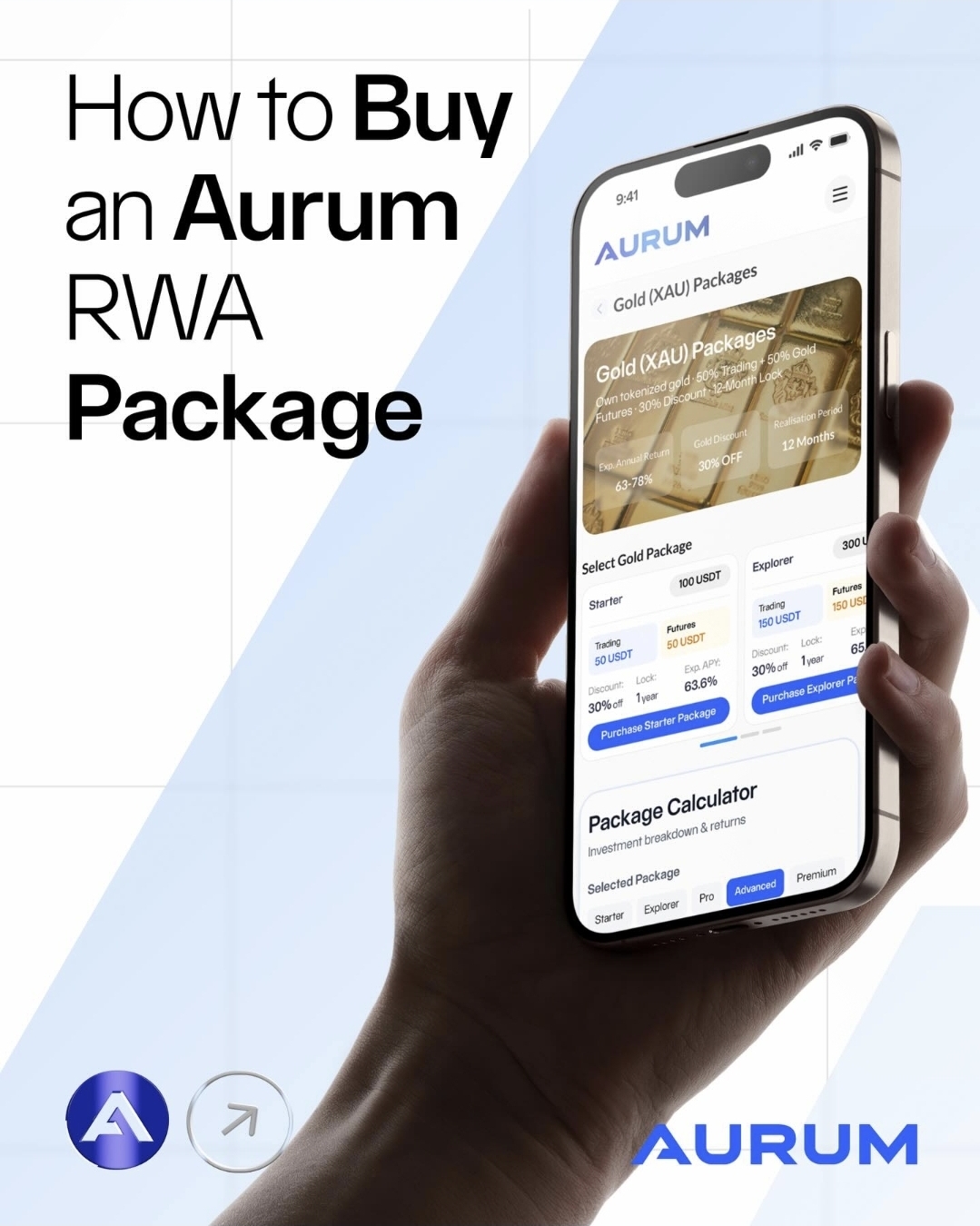
Aurum RWA Gold (XAU) is a structured gold investment product that combines tokenized physical gold ownership with active AI-driven trading — delivering expected annual returns of 63% to 78% depending on the package tier.
The product was developed in partnership with Clinq, led by Nick Patel, founder of the Bank of Bullion. Clinq specializes in tokenizing central bank gold, and the first deal in this partnership focuses on Sierra Leone — a $15 million investment in 22–24 karat African gold acquired at a 30% discount through direct central bank relationships.
That 30% acquisition advantage is not a marketing claim — it's the structural foundation of the entire product. By sourcing gold directly from central bank reserves rather than through retail or wholesale markets, Aurum and Clinq are able to pass a genuine cost advantage on to investors from day one.
How the Hybrid Structure Works
Every Aurum RWA Gold package splits your investment into two equal components, each generating returns independently.
50% goes into Gold Futures Trading (XAUT/PAX). This portion is actively traded using AI-driven strategies against gold-backed instruments. The AI system targets approximately 10% monthly yield on this allocation — generating consistent income regardless of whether the gold price is moving up or down.
50% goes into discounted gold acquisition. This portion purchases physical gold at the 30% central bank discount. After the 12-month lock period, this gold has appreciated in value simply by closing the gap between the acquisition price and market price — before any gold price appreciation is even factored in.
The result is a compounding effect: you're earning trading income on one half of your investment while building a gold position at a structural discount on the other. By the end of the 12-month lock period, both streams have contributed to your total return.
Package Tiers: Starting at 100 USDT
Aurum RWA Gold is accessible at multiple tiers, designed to accommodate a range of investors. Each tier offers the same underlying hybrid structure and benefits, with higher tiers simply allowing for larger investment amounts and potentially greater returns.
You can get started with as little as 100 USDT, making tokenized gold investment accessible to a broad audience. The platform handles all the complexities of gold acquisition, tokenization, and AI-driven trading, providing a seamless experience for investors. See the full details on the AURUM RWA Gold product page, or explore the broader AURUM ecosystem including the EX-AI Bot and NeoBank.
Frequently Asked Questions
What are Real World Assets (RWA)?
Real World Assets (RWA) are physical or traditional financial assets, such as gold, real estate, or government bonds, that are represented as digital tokens on a blockchain. This tokenization makes previously illiquid assets more accessible and tradeable globally.
Why is the RWA market growing rapidly?
The RWA market is experiencing rapid growth due to increasing institutional demand, the creation of real value through post-issuance utility (like using tokenized assets as collateral), and improving regulatory clarity in various jurisdictions. These factors are driving significant capital into the sector.
Why is tokenized gold considered a leading RWA?
Tokenized gold stands out in the RWA market because gold is a universally recognized and trusted store of value with a long history. Its regulatory status is improving under Basel III, and it serves as a reliable hedge against economic instability, making it highly attractive for tokenization.
What are the benefits of Aurum RWA Gold?
Aurum RWA Gold offers a structured investment product combining tokenized physical gold ownership with AI-driven trading strategies. It aims to deliver high annual returns by leveraging a 30% central bank acquisition discount and consistent income from gold futures trading.
How does Aurum RWA Gold generate returns?
Aurum RWA Gold splits investments into two components: 50% for AI-driven gold futures trading targeting monthly yields, and 50% for purchasing physical gold at a 30% discount. This hybrid approach allows for both trading income and appreciation from the discounted gold acquisition.
Ready to grow your wealth with tokenized gold?
Join Aurum RWA Gold and experience the future of secure, high-yield gold investment.
Ready to Experience AURUM?
Create your free account and start exploring the platform today—no credit card required
About AURUM Foundation
AURUM Foundation
AURUM Foundation is an AI-powered DeFi ecosystem helping over 300,000 partners worldwide achieve financial freedom through automated crypto trading bots, flash loan arbitrage, and tokenized gold-backed assets. With $800M+ in assets under management, AURUM delivers institutional-grade tools to everyday investors.