Will AI Take Your Job? How to Build Passive Income Before It Does
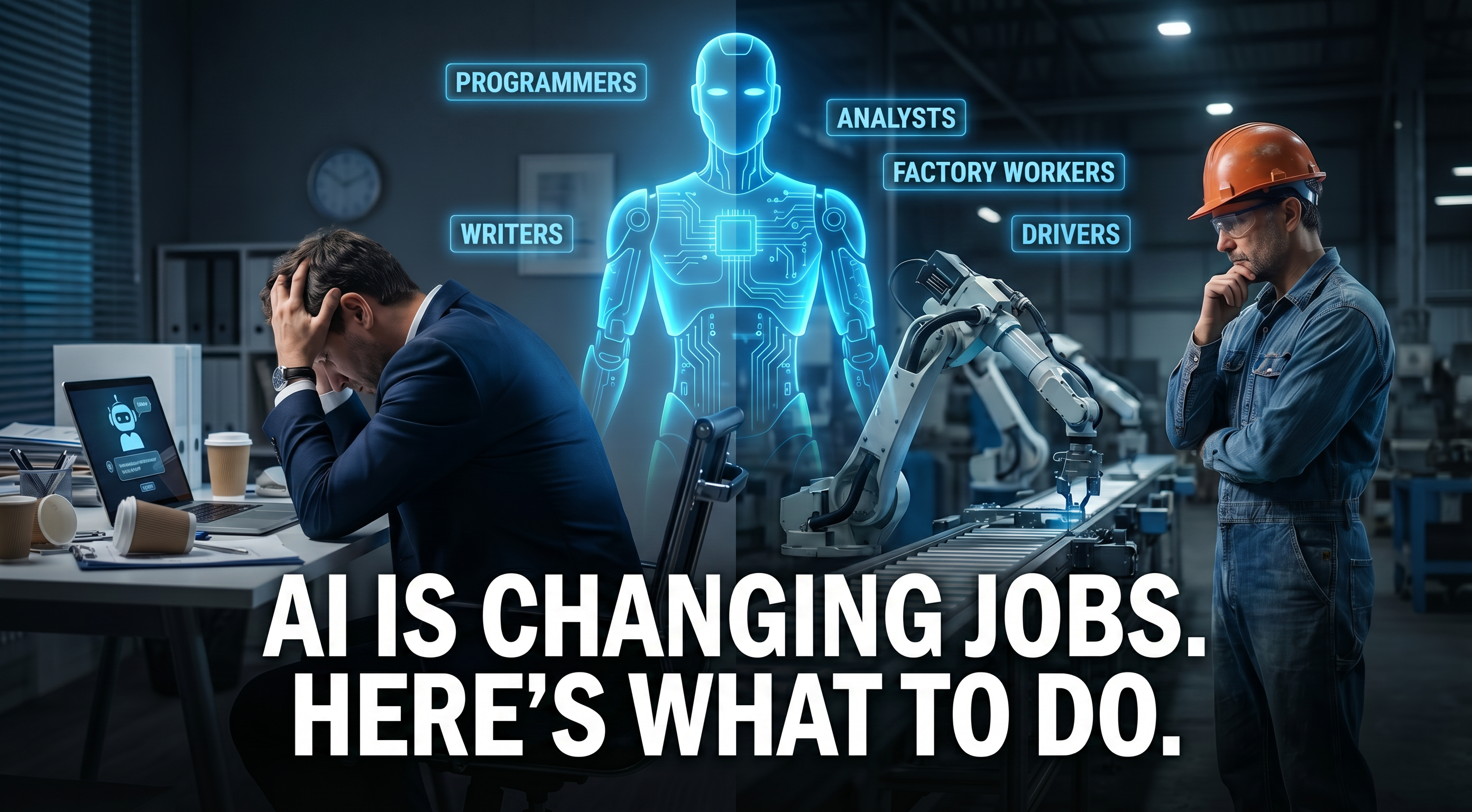
For the past decade, the conversation about AI and jobs focused almost entirely on factory floors and assembly lines. Robots replacing welders. Automated conveyor belts replacing warehouse pickers. The assumption was clear: if you had a degree, a desk, and a laptop, you were safe. That assumption is being seriously tested.
The data coming out of 2024 and 2025 tells a more nuanced story — one that is relevant to anyone working in an office, not just anyone working in a plant. Programmers, financial analysts, writers, administrative staff, customer service managers, and web designers are now among the roles most exposed to AI displacement. The collar colour no longer matters. What matters is whether your core tasks can be replicated by a language model, a code generator, or an automated workflow — and for a growing number of white-collar professionals, the answer is yes.
The Numbers Are Not Abstract Anymore
Research published in early 2026 revealed that more than 276,000 tech workers lost their jobs to AI-driven layoffs between 2024 and 2025. These were not low-skill roles. They were software engineers, data analysts, technical writers, and QA specialists — people with degrees, certifications, and years of experience. According to Goldman Sachs Global Investment Research, employment among workers aged 22 to 25 in AI-exposed occupations fell 6% between late 2022 and mid-2025. Young software developers specifically saw a nearly 20% decline over the same period.
The World Economic Forum's Future of Jobs Report 2025 — the largest global employer survey of its kind, covering more than 1,000 companies representing 14 million workers across 55 economies — found that 44% of workers' core skills are expected to change by 2030. Administrative and secretarial roles were ranked among the top three occupational categories facing the greatest disruption. The WEF projects 92 million job displacements globally by 2030, offset by 170 million new role creations — but the people who lose those roles and the people who gain the new ones are rarely the same individuals.
A February 2026 report covered by Forbes, drawing on Microsoft Research data, found that financial managers face 84% task exposure to AI, computer and mathematical roles face 67% exposure, and business and financial operations roles face 60–68% exposure. These are not entry-level positions. These are mid-career and senior professionals whose core daily work — analysis, reporting, forecasting, documentation — is precisely what large language models do well.
This Is Not Just a Tech Problem
It would be convenient to frame this as a Silicon Valley story — overpaid engineers getting a dose of reality. But the displacement is broader than that. Research published in April 2026 identified writers and authors, computer programmers, and web and digital interface designers as among the most vulnerable occupational categories — roles that exist in every industry, not just technology.
The US Bureau of Labor Statistics projects an 8% decline in secretarial and administrative assistant employment through 2032 — approximately 140,000 fewer positions. McKinsey Global Institute found that up to 69% of data collection and processing tasks — the core activity of most administrative, clerical, and entry-level white-collar roles — carry automation potential with technology available today. A separate McKinsey finding: today's deployed AI could theoretically automate approximately 57% of all US work hours across the entire workforce.
On the factory floor, the story is equally stark. Robotic arms, automated quality control systems, and AI-driven logistics platforms have been steadily reducing headcount in manufacturing, warehousing, and transportation for years. Drivers, assemblers, and machine operators face the same structural pressure — just through a different technological mechanism. The common thread is not the type of work. It is the predictability of the task. If a job can be broken into repeatable steps, AI or automation can eventually do it cheaper and faster.
According to a survey by the American Psychological Association, 47% of employed Americans used AI tools at least monthly in 2025, up from 34% the prior year — the fastest adoption curve for any workplace technology since personal computing. The same survey found that workers in AI-exposed roles reported significantly higher levels of job anxiety and uncertainty about their career direction.
The Question Nobody Is Asking Loudly Enough
Most of the coverage around AI and employment focuses on the displacement side. Fewer articles ask the more practical question: if AI is going to reduce the demand for your labour, what do you do with that information?
There are broadly two responses. The first is to wait and hope — to assume your specific role is safe, that your employer values you enough to keep you on, and that the disruption will slow down before it reaches your desk. The second is to get ahead of it — to start building income streams that do not depend entirely on selling your time to a single employer.
The irony is that the same AI infrastructure displacing workers in traditional employment is also creating new opportunities for individuals who know how to use it. AI-powered trading systems, automated financial tools, and DeFi platforms are generating returns that were previously only accessible to institutional investors or people with significant capital and technical expertise. That gap is closing.
How Some People Are Using AI to Build Income on Their Own Terms
A growing number of individuals — particularly those who saw the writing on the wall early — have been building passive income through AI-powered financial platforms. The logic is straightforward: if AI is efficient enough to replace a financial analyst's work, it is efficient enough to execute trading strategies faster, more consistently, and with less emotional interference than a human trader.
Platforms like the Aurum EX-AI Bot operate on exactly this principle. The bot runs automated crypto trading strategies around the clock, executing positions based on real-time market data without requiring the user to monitor charts or make manual decisions. For someone whose income is under pressure from AI displacement in their day job, this represents a meaningful alternative — a way to put capital to work using the same technology that is reshaping the labour market.
Independent crypto reviewer Brad — a 20-year veteran of the space known for exposing fraudulent platforms — reviewed Aurum in detail and concluded that the platform is functioning as described. He noted the 300,000 active partners milestone as evidence of organic, sustained growth rather than manufactured hype. His full independent review is available here.
The Aurum ecosystem also includes a NeoBank with integrated financial tools, a crypto debit card, and access to flash loan infrastructure — a suite of products designed to give individuals access to financial tools that were previously reserved for institutions. The platform is registered and licensed in Canada as AURUM NEYRO AI TECHNOLOGIES CORP. (Company No. BC1571382, British Columbia), providing a regulated foundation for the ecosystem.
This Is Not About Getting Rich Quick
It is worth being direct about what this is and what it is not. Building passive income through AI-powered financial tools is not a guaranteed path to wealth, and it is not a replacement for financial literacy or due diligence. The crypto market is volatile. Automated trading systems carry risk. Anyone who tells you otherwise is not being honest.
What it is, however, is a legitimate response to a legitimate structural problem. If the labour market is being reshaped by AI — and the data strongly suggests it is — then waiting passively for that reshaping to reach your role is not a strategy. Diversifying your income, building financial resilience, and using the same technology that is disrupting employment to generate returns on your own terms is a rational response to an irrational situation.
According to a CNBC Workforce Executive Council survey, 89% of HR leaders expect AI to impact jobs in 2026. BCG's April 2026 research found that 50–55% of US jobs will be reshaped by AI in the next two to three years. These are not fringe predictions from technology optimists. They are mainstream projections from the institutions that shape hiring decisions.
The question is not whether AI will affect your income. For most people, it already is or soon will be. The question is whether you are positioned to adapt — or whether you are waiting for someone else to solve the problem for you.
Sources & Further Reading
- Goldman Sachs Global Investment Research — How Will AI Affect the US Labor Market? (March 2026)
- World Economic Forum — Future of Jobs Report 2025
- Forbes / Microsoft Research — Jobs Most and Least Impacted by AI (February 2026)
- Inside Higher Ed — Which Jobs Are Most at Risk in the Age of AI? (April 2026)
- American Psychological Association — Work in America Survey, Spring 2025
- McKinsey Global Institute — A Future That Works (2017); AI in the Workplace (2025)
- US Bureau of Labor Statistics — Occupational Outlook Handbook 2023–2033
Frequently Asked Questions
Which jobs are most at risk from AI in 2026?
According to Microsoft Research and Forbes (February 2026), financial managers face 84% task exposure to AI, computer and mathematical roles face 67%, and business and financial operations roles face 60–68%. Writers, programmers, and administrative staff are also among the most vulnerable categories identified by multiple research bodies including the WEF and Inside Higher Ed.
Is AI replacing white-collar workers as well as blue-collar workers?
Yes. The data from 2024–2026 shows that AI displacement is not limited to factory or manual labour. Over 276,000 tech workers lost jobs to AI-driven layoffs between 2024 and 2025. Goldman Sachs research found that employment among young software developers fell nearly 20% over the same period. White-collar roles involving analysis, writing, coding, and administration are now among the most exposed.
How can I protect my income from AI job displacement?
Financial experts recommend diversifying income streams so you are not entirely dependent on a single employer. One approach gaining traction is using AI-powered financial platforms — such as automated crypto trading bots — to generate passive income alongside traditional employment. This allows individuals to put capital to work using the same technology reshaping the labour market.
What percentage of US jobs will be affected by AI?
BCG research published in April 2026 found that 50–55% of US jobs will be reshaped by AI in the next two to three years. The World Economic Forum projects 92 million job displacements globally by 2030, offset by 170 million new role creations — though the people losing existing roles and those gaining new ones are rarely the same individuals.
What is the Aurum EX-AI Bot and how does it work?
The Aurum EX-AI Bot is an automated crypto trading platform that executes trading strategies around the clock based on real-time market data, without requiring users to monitor charts or make manual decisions. It is part of the Aurum Foundation ecosystem, registered in Canada as AURUM NEYRO AI TECHNOLOGIES CORP. (Company No. BC1571382, British Columbia).
Get Ahead of the Shift
Over 300,000 partners are already using Aurum's AI-powered financial tools to build income that doesn't depend on a single employer. Create your free account — no credit card required — and explore what the platform can do. Learn more about the Aurum ecosystem.
Ready to Experience AURUM?
Create your free account and start exploring the platform today—no credit card required
About AURUM Foundation
AURUM Foundation
AURUM Foundation is an AI-powered DeFi ecosystem helping over 300,000 partners worldwide achieve financial freedom through automated crypto trading bots, flash loan arbitrage, and tokenized gold-backed assets. With $800M+ in assets under management, AURUM delivers institutional-grade tools to everyday investors.